Home Volume 3 Number 3

Oct. 2004 · Volume 3 Number 3

Volume 3 Number 3

Articles in this issue

Recovering Resilience (Part 1)

On the Road to Restoration?

Explore the concept of ecological resilience from the vantage point of scientists actively engaged in studying the ecology and potential for restoration of this Bay and also from that of experts confronting similar issues nationwide. Chesapeake Quarterly, Maryland Sea Grant's quarterly magazine, reports on research, extension, education and other Chesapeake Bay issues and activities of interest to the marine community. It is produced and funded by this program, which receives support from the National Oceanic and Atmospheric Administration. Managing Editor, Sandy Rodgers; Contributing Editors, Jack Greer and Michael Fincham; Science Writer, Erica Goldman. more . . . about Recovering Resilience (Part 1)
The Language of Resilience

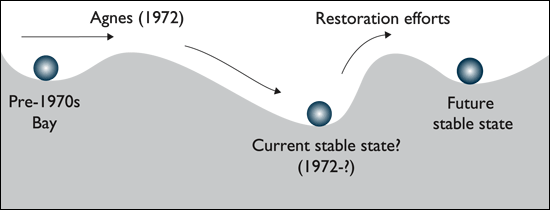
Resilience is a formal theoretical construct that has its roots in dynamic systems theory - the body of math that characterizes the behavior of complex systems. Ecologists use two different definitions of the term: engineering resilience and ecological resilience. Engineering resilience is defined as the rate at which a system returns to a stable state following a perturbation. This assumes that a system does not, after a perturbation, shift into an alternate state. Ecological resilience, in contrast, is measured by the magnitude of disturbance that can be absorbed before the system changes its structure. This definition applies both to ecological and social systems and it assumes from the outset that there exist multiple stable states for any given system. Chesapeake Quarterly, Maryland Sea Grant's quarterly magazine, reports on research, extension, education and other Chesapeake Bay issues and activities of interest to the marine community. It is produced and funded by this program, which receives support from the National Oceanic and Atmospheric Administration. Managing Editor, Sandy Rodgers; Contributing Editors, Jack Greer and Michael Fincham; Science Writer, Erica Goldman. more . . . about The Language of Resilience

Towards Adaptive Management

Ideas like stable states and thresholds may help us think about how ecosystems work, but translating theoretical precepts into practical management can be a tall order. For the Chesapeake, restoration aimed at recapturing at least some of the past is largely uncharted territory, one that will require management efforts that can be constantly tweaked and fine-tuned as they progress. And, while scientists can provide advice and insight into what a system might look like as it moves along a restoration trajectory, ultimately the decisions rest with those who use the Bay and live in the surrounding watershed to determine what ecological and economic services they want it to provide. Chesapeake Quarterly, Maryland Sea Grant's quarterly magazine, reports on research, extension, education and other Chesapeake Bay issues and activities of interest to the marine community. It is produced and funded by this program, which receives support from the National Oceanic and Atmospheric Administration. Managing Editor, Sandy Rodgers; Contributing Editors, Jack Greer and Michael Fincham; Science Writer, Erica Goldman. more . . . about Towards Adaptive Management

Identifying Thresholds

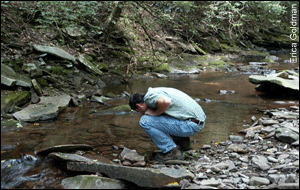
Ranging from pristine to degraded, streams in western Maryland run the gamut. Acid mine drainage releases sulfuric acid and iron from the rock, turning the water burnt orange. The acidity of the water can also cause white toxic foam to bubble out of aluminum-rich rocks. Chesapeake Quarterly, Maryland Sea Grant's quarterly magazine, reports on research, extension, education and other Chesapeake Bay issues and activities of interest to the marine community. It is produced and funded by this program, which receives support from the National Oceanic and Atmospheric Administration. Managing Editor, Sandy Rodgers; Contributing Editors, Jack Greer and Michael Fincham; Science Writer, Erica Goldman. more . . . about Identifying Thresholds

A Meeting of Minds

Ranging from pristine to degraded, streams in western Maryland run the gamut. Acid mine drainage releases sulfuric acid and iron from the rock, turning the water burnt orange. The acidity of the water can also cause white toxic foam to bubble out of aluminum-rich rocks. Chesapeake Quarterly, Maryland Sea Grant's quarterly magazine, reports on research, extension, education and other Chesapeake Bay issues and activities of interest to the marine community. It is produced and funded by this program, which receives support from the National Oceanic and Atmospheric Administration. Managing Editor, Sandy Rodgers; Contributing Editors, Jack Greer and Michael Fincham; Science Writer, Erica Goldman. more . . . about A Meeting of Minds

Recovering Resilience (Part 4)

On the Road To Restoration?

Explore the concept of ecological resilience from the vantage point of scientists actively engaged in studying the ecology and potential for restoration of this Bay and also from that of experts confronting similar issues nationwide. Chesapeake Quarterly, Maryland Sea Grant's quarterly magazine, reports on research, extension, education and other Chesapeake Bay issues and activities of interest to the marine community. It is produced and funded by this program, which receives support from the National Oceanic and Atmospheric Administration. Managing Editor, Sandy Rodgers; Contributing Editors, Jack Greer and Michael Fincham; Science Writer, Erica Goldman. more . . . about Recovering Resilience (Part 4)

A New Bay for the Oyster?

Ranging from pristine to degraded, streams in western Maryland run the gamut. Acid mine drainage releases sulfuric acid and iron from the rock, turning the water burnt orange. The acidity of the water can also cause white toxic foam to bubble out of aluminum-rich rocks. Chesapeake Quarterly, Maryland Sea Grant's quarterly magazine, reports on research, extension, education and other Chesapeake Bay issues and activities of interest to the marine community. It is produced and funded by this program, which receives support from the National Oceanic and Atmospheric Administration. Managing Editor, Sandy Rodgers; Contributing Editors, Jack Greer and Michael Fincham; Science Writer, Erica Goldman. more . . . about A New Bay for the Oyster?

Et Cetera

Chesapeake Quarterly, Maryland Sea Grant's quarterly magazine, reports on research, extension, education and other Chesapeake Bay issues and activities of interest to the marine community. It is produced and funded by this program, which receives support from the National Oceanic and Atmospheric Administration. Managing Editor, Sandy Rodgers; Contributing Editors, Jack Greer and Michael Fincham; Science Writer, Erica Goldman. more . . . about Et Cetera

Video Spotlights

Chesapeake Quarterly, Maryland Sea Grant's quarterly magazine, reports on research, extension, education and other Chesapeake Bay issues and activities of interest to the marine community. It is produced and funded by this program, which receive support from the National Oceanic and Atmospheric Administration. Managing Editor, Sandy Rodgers; Contributing Editors, Jack Greer and Merrill Leffler. more . . . about Video Spotlights

Recovering Resilience (Part 2)

On the Road To Restoration?

Explore the concept of ecological resilience from the vantage point of scientists actively engaged in studying the ecology and potential for restoration of this Bay and also from that of experts confronting similar issues nationwide. Chesapeake Quarterly, Maryland Sea Grant's quarterly magazine, reports on research, extension, education and other Chesapeake Bay issues and activities of interest to the marine community. It is produced and funded by this program, which receives support from the National Oceanic and Atmospheric Administration. Managing Editor, Sandy Rodgers; Contributing Editors, Jack Greer and Michael Fincham; Science Writer, Erica Goldman. more . . . about Recovering Resilience (Part 2)