Home Volume 5 Number 2

Sep. 2006 · Volume 5 Number 2

Volume 5 Number 2

Articles in this issue

The Mystery Invasion of Chesapeake Bay

The MSX Files
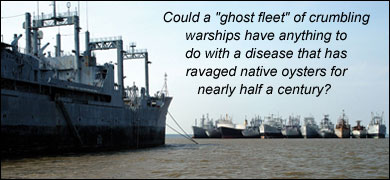
The bottom of Chesapeake Bay is a battleground littered with the empty shells of dead oysters. Gone, for the most part, are the living oyster reefs that once created habitat for small fish and crabs and helped filter Bay waters now cloudy with excess plankton. Battles rage not over how to harvest the reefs, but how best to rebuild them. Should we replant the Bay with native oysters or with non-natives imported from China? The answer may depend in part on another question: what killed off the oyster reefs of the Chesapeake in the first place? The suspects include disease, overfishing, sedimentation, habitat destruction, and water quality changes. Chesapeake Quarterly, Maryland Sea Grant's quarterly magazine, reports on research, extension, education and other Chesapeake Bay issues and activities of interest to the marine community. It is produced and funded by this program, which receives support from the National Oceanic and Atmospheric Administration. Managing Editor, Sandy Rodgers; Contributing Editors, Jack Greer and Michael Fincham; Science Writer, Erica Goldman. more . . . about The Mystery Invasion of Chesapeake Bay
The Culture of Disease

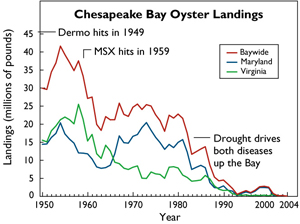
Dermo arrived early in the Chesapeake, but its effect in Maryland wasn't fully felt until years after MSX hit, when drought caused both diseases, which thrive in higher salinities, to spread. Together, these diseases decimated what was once the Chesapeake's most valuable fishery. Chesapeake Quarterly, Maryland Sea Grant's quarterly magazine, reports on research, extension, education and other Chesapeake Bay issues and activities of interest to the marine community. It is produced and funded by this program, which receives support from the National Oceanic and Atmospheric Administration. Managing Editor, Sandy Rodgers; Contributing Editors, Jack Greer and Michael Fincham; Science Writer, Erica Goldman. more . . . about The Culture of Disease

The Missing Link

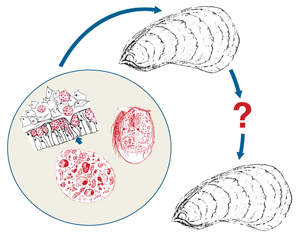
Since the 1960s, generations of scientists studying MSX have searched for answers to the transmission question. They've found that native oysters never 'catch' an MSX infection in the lab from infected oysters placed next to them. But when scientists place healthy oysters in a Bay area empty of oysters, the clean oysters 'catch' a heavy MSX infection -- and very quickly. Since other oysters apparently do not release infective particles, some other animal -- the alternate host -- must be releasing MSX. Chesapeake Quarterly, Maryland Sea Grant's quarterly magazine, reports on research, extension, education and other Chesapeake Bay issues and activities of interest to the marine community. It is produced and funded by this program, which receives support from the National Oceanic and Atmospheric Administration. Managing Editor, Sandy Rodgers; Contributing Editors, Jack Greer and Michael Fincham; Science Writer, Erica Goldman. more . . . about The Missing Link

New Guide to Underwater Grasses

nderwater grasses, or submerged aquatic vegetation (SAV), play a key role in the ecology of coastal waters, and especially in Chesapeake Bay. This 80-page guide features more than 100 color photographs, 55 line drawings and helpful descriptions of 20 of the most common SAV species, along with other aquatic species you might see. T Chesapeake Quarterly, Maryland Sea Grant's quarterly magazine, reports on research, extension, education and other Chesapeake Bay issues and activities of interest to the marine community. It is produced and funded by this program, which receives support from the National Oceanic and Atmospheric Administration. Managing Editor, Sandy Rodgers; Contributing Editors, Jack Greer and Michael Fincham; Science Writer, Erica Goldman. more . . . about New Guide to Underwater Grasses