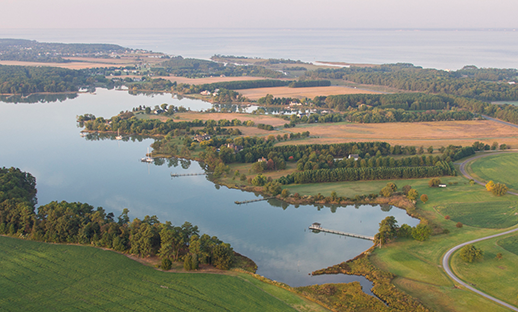
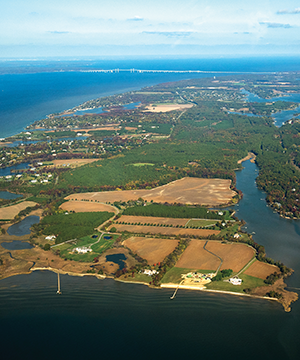
Since the 1980s, a federal-state partnership has labored to restore the nation's largest estuary. Known as the Chesapeake Bay Program, it is managed by the Environmental Protection Agency (EPA) and has more than 100 partners, including the six states and the District of Columbia whose waters drain into the Bay. All share an urgent goal: to improve the water quality of the Chesapeake Bay and restore the estuary's health to a sustainable level. Now the Chesapeake Bay Program has reached an important milestone. The program is conducting a 'midpoint assessment,' a review of the Chesapeake Bay Model, the key tool the program uses to set cleanup goals for the rivers and mainstem of the Bay and to measure progress in achieving them. This midpoint assessment lies halfway between two other important dates - one past (2010), one to come (2025). Chesapeake Quarterly, Maryland Sea Grant's quarterly magazine, reports on research, extension, education and other Chesapeake Bay issues and activities of interest to the marine community. It is produced and funded by this program, which receives support from the National Oceanic and Atmospheric Administration. Maryland Sea Grant College staff: Director, Fredrika Moser; Assistant Director of Communications, Jeffrey Brainard; Magazine Editor, Michael W. Fincham, Science Writer, Daniel Pendick; Production Editor/Art Director, Nicole Lehming.
more . . . about Using Models and Science for Better Bay Decisions
A computer simulation of the Bay runs on Garnet, a supercomputer at the Department of Defense Supercomputing Resource Center in Vicksburg, Mississippi. Carl Cerco, an estuary modeler at the U.S. Army Corps of Engineers, works with computer scientist Mark Noel to run simulations of the Bay's water quality. Chesapeake Quarterly, Maryland Sea Grant's quarterly magazine, reports on research, extension, education and other Chesapeake Bay issues and activities of interest to the marine community. It is produced and funded by this program, which receives support from the National Oceanic and Atmospheric Administration. Maryland Sea Grant College staff: Director, Fredrika Moser; Assistant Director of Communications, Jeffrey Brainard; Magazine Editor, Michael W. Fincham, Science Writer, Daniel Pendick; Production Editor/Art Director, Nicole Lehming.
more . . . about Digital Bay Models Take Over
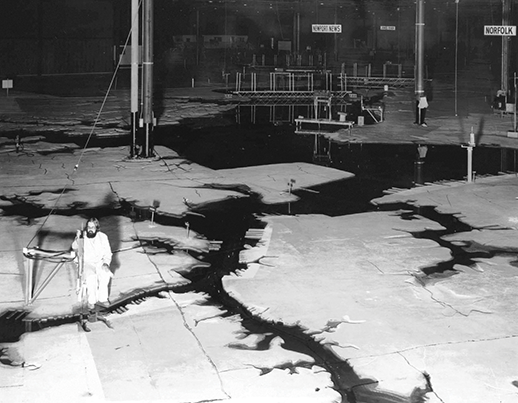
A computer model is a master mimic: it takes what nature does in all its complexity and tries to reproduce a believable version of it using mathematical equations. By the early 1980s, estuarine scientists and programmers were already developing the first computer models of the Chesapeake Bay. These models have become invaluable tools to inform key decisions in the ongoing federal-state partnership to clean up the largest estuary in the nation. But as Chesapeake scientists and policy makers were saying hello to the new computer tools, they were waving a fond farewell to a very different kind of model: a physical mini-replica of the estuary called the Chesapeake Bay Hydraulic Model. Chesapeake Quarterly, Maryland Sea Grant's quarterly magazine, reports on research, extension, education and other Chesapeake Bay issues and activities of interest to the marine community. It is produced and funded by this program, which receives support from the National Oceanic and Atmospheric Administration. Maryland Sea Grant College staff: Director, Fredrika Moser; Assistant Director of Communications, Jeffrey Brainard; Magazine Editor, Michael W. Fincham, Science Writer, Daniel Pendick; Production Editor/Art Director, Nicole Lehming.
more . . . about The Rise and Fall of the Matapeake Monster
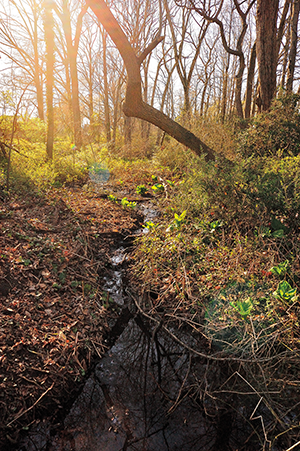
Building a corps of citizen stewards is now an integral part of the ongoing effort to restore the Chesapeake Bay. Many graduates of that first academy class continue to lead community watershed restoration projects. In all, more than 300 master watershed stewards have been trained in Maryland. Chesapeake Quarterly, Maryland Sea Grant's quarterly magazine, reports on research, extension, education and other Chesapeake Bay issues and activities of interest to the marine community. It is produced and funded by this program, which receives support from the National Oceanic and Atmospheric Administration. Maryland Sea Grant College staff: Director, Fredrika Moser; Assistant Director of Communications, Jeffrey Brainard; Magazine Editor, Michael W. Fincham, Science Writer, Daniel Pendick; Production Editor/Art Director, Nicole Lehming.
more . . . about TCleaning Up Stormwater Pollution One Town at a Time
Five graduate students supported by Maryland Sea Grant have begun working for federal agencies in Washington, D.C., as 2017 Knauss Marine Policy Fellows - our largest class ever. They will spend one year on projects that include improving international partnerships, fisheries management, and monitoring of water pollutants. Chesapeake Quarterly, Maryland Sea Grant's quarterly magazine, reports on research, extension, education and other Chesapeake Bay issues and activities of interest to the marine community. It is produced and funded by this program, which receives support from the National Oceanic and Atmospheric Administration. Maryland Sea Grant College staff: Director, Fredrika Moser; Assistant Director of Communications, Jeffrey Brainard; Magazine Editor, Michael W. Fincham, Science Writer, Daniel Pendick; Production Editor/Art Director, Nicole Lehming.
more . . . about Maryland's 2017 Knauss Fellowships
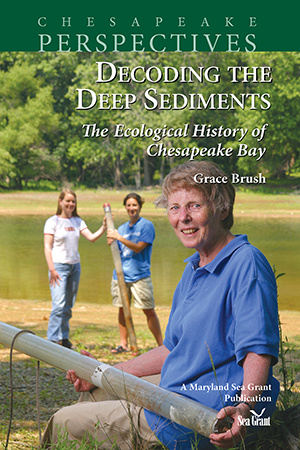
The sediments of Chesapeake Bay harbor a record of the Bay's ecology, from its 'natural functioning' thousands of years before European colonization through post-Colonial settlement up to the current, continuing forest clearance across the watershed. Translating that record into a history of ecological change has been the focus of Grace Brush's research at the Johns Hopkins University for more than thirty years. Brush explains the nature of these studies in her new book, 'Decoding the Deep Sediments: The Ecological History of Chesapeake Bay', published by Maryland Sea Grant as the fifth installment in our Chesapeake Perspectives series.
Chesapeake Quarterly, Maryland Sea Grant's quarterly magazine, reports on research, extension, education and other Chesapeake Bay issues and activities of interest to the marine community. It is produced and funded by this program, which receives support from the National Oceanic and Atmospheric Administration. Maryland Sea Grant College staff: Director, Fredrika Moser; Assistant Director of Communications, Jeffrey Brainard; Magazine Editor, Michael W. Fincham, Science Writer, Daniel Pendick; Production Editor/Art Director, Nicole Lehming.
more . . . about Grace Brush Traces the Bay's Ecological History