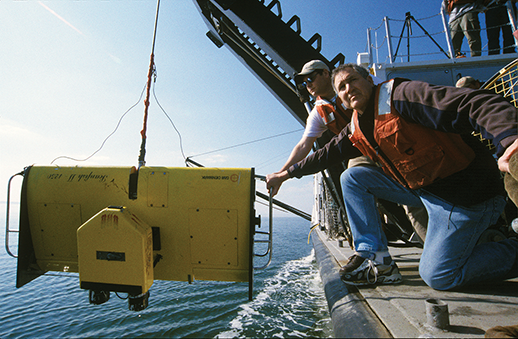
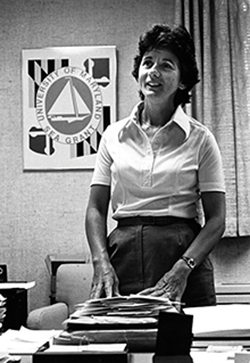
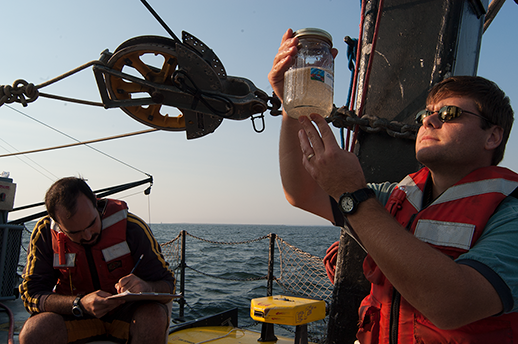
Maryland Sea Grant supports a special mix of programming that employs science to address serious challenges confronting the Bay's ecology and the people who enjoy and make a living from its natural resources. We support research to better understand how we can restore and sustain the health of the estuary. Our portfolio includes supporting educational activities to foster an informed citizenry and the next generation of coastal scientists. We provide technical expertise that helps Maryland's seafood industry create and sustain jobs. And we assist a variety of community organizations to improve the Chesapeake Bay's water quality and coastal land use. In 1966, Congress presciently established the National Sea Grant College Program, of which Maryland Sea Grant is a part, because legislators recognized the need for science-based policy for our coastal and estuarine ecosystems to benefit a variety of constituents including resource managers, decision makers, businesses, and citizen volunteers. Chesapeake Quarterly explores scientific, environmental, and cultural issues relevant to the Chesapeake Bay and its watershed. The magazine is produced and funded by the Maryland Sea Grant College. The college receives support from the National Oceanic and Atmospheric Administration and the state of Maryland. Maryland Sea Grant College staff: Director, Fredrika Moser; Director of Communications, Jeffrey Brainard; Editors, Michael W. Fincham, Merrill Leffler, and Sandy Rodgers. Production Editor/Art Director, Nicole Lehming,
more . . . about Harnessing the Power of Science to Improve Maryland's Coast
Life has lately turned more hectic for lab directors on both sides of the Chesapeake Bay. At this key moment in the multi-state campaign to restore the estuary, they have a new problem on their hands: a lot of well-known scientists are leaving. Turnovers can be times of evolution. In looking for new hires, lab directors have the chance to recruit scientists in emerging fields such as molecular biology, advanced statistics, and coastal synthesis science. And these new researchers will have their chance to apply their approaches to solving issues now facing the Chesapeake Bay ecosystem. Chesapeake Quarterly explores scientific, environmental, and cultural issues relevant to the Chesapeake Bay and its watershed. The magazine is produced and funded by the Maryland Sea Grant College. The college receives support from the National Oceanic and Atmospheric Administration and the state of Maryland. Maryland Sea Grant College staff: Director, Fredrika Moser; Director of Communications, Jeffrey Brainard; Editors, Michael W. Fincham, Merrill Leffler, and Sandy Rodgers. Production Editor/Art Director, Nicole Lehming,
more . . . about Overture for a New Estuary
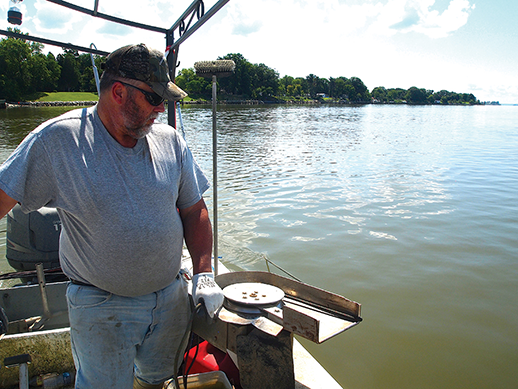
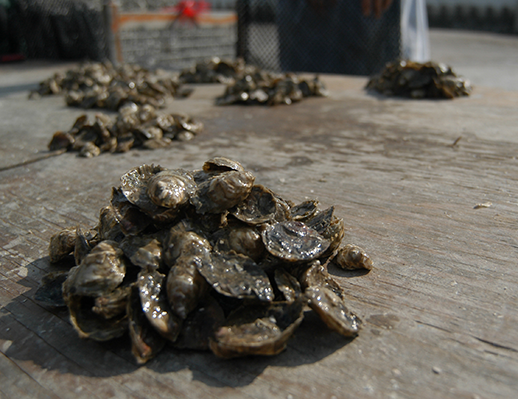
For most of the 20th century, obtaining oyster leases was nearly impossible in every Maryland tributary except the Nanticoke River, where a large oyster shucking and canning company operated. Watermen opposed leasing at every turn, arguing that it would open the Chesapeake to large corporate interests and put them out of business. They preferred the system they had, where the state planted shell and seeded beds at oystermen's request so they could harvest oysters during a limited season. That changed in 2009, when the Maryland legislature allowed oyster leasing in every county. Chesapeake Quarterly explores scientific, environmental, and cultural issues relevant to the Chesapeake Bay and its watershed. The magazine is produced and funded by the Maryland Sea Grant College. The college receives support from the National Oceanic and Atmospheric Administration and the state of Maryland. Maryland Sea Grant College staff: Director, Fredrika Moser; Director of Communications, Jeffrey Brainard; Editors, Michael W. Fincham, Merrill Leffler, and Sandy Rodgers. Production Editor/Art Director, Nicole Lehming,
more . . . about Seeding An Industry
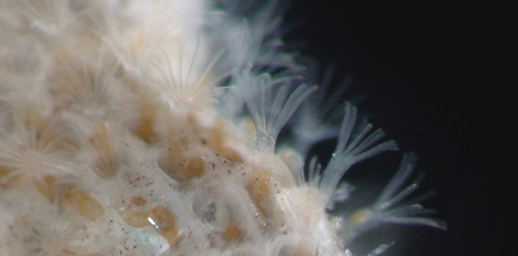
On a warm September morning in Baltimore's Inner Harbor, the traffic steadily moving along on Pratt Street, Chris Tollini is perched on a ledge just above the harbor's murky water. He's pulling up the first of thirteen PVC pipes, each with stacks of black-encrusted discs along the length of the pipes. These acrylic discs were clean when first lowered into the water nearly six months before - now they are teeming with life: mussels, barnacles, and other organisms such as bryozoans and hydroids. These living microcolonies are destined for high school labs and students who are studying the ecology of this polluted urban harbor. Chesapeake Quarterly explores scientific, environmental, and cultural issues relevant to the Chesapeake Bay and its watershed. The magazine is produced and funded by the Maryland Sea Grant College. The college receives support from the National Oceanic and Atmospheric Administration and the state of Maryland. Maryland Sea Grant College staff: Director, Fredrika Moser; Director of Communications, Jeffrey Brainard; Editors, Michael W. Fincham, Merrill Leffler, and Sandy Rodgers. Production Editor/Art Director, Nicole Lehming,
more . . . about Living Micro-Reefs Bring Excitement to the Classroom
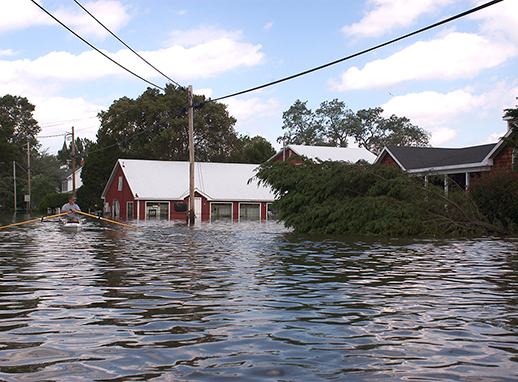
When the rains fall on Maryland's Eastern Shore and the tide is high, flooding is often not far behind. Some residents in Oxford move their cars to higher ground when the forecast predicts only light rain. Like other low-lying coastal communities, Oxford has often endured flooding - the soil drains slowly and stormwater can linger for days, sometimes stranding residents in their homes Chesapeake Quarterly explores scientific, environmental, and cultural issues relevant to the Chesapeake Bay and its watershed. The magazine is produced and funded by the Maryland Sea Grant College. The college receives support from the National Oceanic and Atmospheric Administration and the state of Maryland. Maryland Sea Grant College staff: Director, Fredrika Moser; Director of Communications, Jeffrey Brainard; Editors, Michael W. Fincham, Merrill Leffler, and Sandy Rodgers. Production Editor/Art Director, Nicole Lehming,
more . . . about Partners in Stormwater Control
From its beginning, Maryland Sea Grant Communications has been reaching out to our many audiences in the Chesapeake Bay and coastal regions by creating products that address issues important to the region. Topics we’ve covered include oyster biology and disease, sustainable blue crab populations, fisheries management, sea level rise, and declining seagrasses. Below are selected highlights of our efforts. Chesapeake Quarterly explores scientific, environmental, and cultural issues relevant to the Chesapeake Bay and its watershed. The magazine is produced and funded by the Maryland Sea Grant College. The college receives support from the National Oceanic and Atmospheric Administration and the state of Maryland. Maryland Sea Grant College staff: Director, Fredrika Moser; Director of Communications, Jeffrey Brainard; Editors, Michael W. Fincham, Merrill Leffler, and Sandy Rodgers. Production Editor/Art Director, Nicole Lehming,
more . . . about 40 Years of Communicating Bay Science
Maryland Sea Grant supports a special mix of programming that employs science to address serious challenges confronting the Bay's ecology and the people who enjoy and make a living from its natural resources. We support research to better understand how we can restore and sustain the health of the estuary. Our portfolio includes supporting educational activities to foster an informed citizenry and the next generation of coastal scientists. We provide technical expertise that helps Maryland's seafood industry create and sustain jobs. And we assist a variety of community organizations to improve the Chesapeake Bay's water quality and coastal land use. In 1966, Congress presciently established the National Sea Grant College Program, of which Maryland Sea Grant is a part, because legislators recognized the need for science-based policy for our coastal and estuarine ecosystems to benefit a variety of constituents including resource managers, decision makers, businesses, and citizen volunteers. Chesapeake Quarterly explores scientific, environmental, and cultural issues relevant to the Chesapeake Bay and its watershed. The magazine is produced and funded by the Maryland Sea Grant College. The college receives support from the National Oceanic and Atmospheric Administration and the state of Maryland. Maryland Sea Grant College staff: Director, Fredrika Moser; Director of Communications, Jeffrey Brainard; Editors, Michael W. Fincham, Merrill Leffler, and Sandy Rodgers. Production Editor/Art Director, Nicole Lehming,
more . . . about 40 Years of Science and Resource Management
One focus for Maryland Sea Grant has been addressing the problems facing commercial fisheries in the Chesapeake Bay. Our research findings have helped improve management of the fisheries for oysters and blue crabs, and the University of Maryland Extension specialists have been providing the technology and training for reviving oyster aquaculture. In addition, our staff experts helped reshape the state's fisheries policies by working with the Bi-State Blue Crab Advisory Committee and the Governor's Oyster Advisory Commission. Chesapeake Quarterly explores scientific, environmental, and cultural issues relevant to the Chesapeake Bay and its watershed. The magazine is produced and funded by the Maryland Sea Grant College. The college receives support from the National Oceanic and Atmospheric Administration and the state of Maryland. Maryland Sea Grant College staff: Director, Fredrika Moser; Director of Communications, Jeffrey Brainard; Editors, Michael W. Fincham, Merrill Leffler, and Sandy Rodgers. Production Editor/Art Director, Nicole Lehming,
more . . . about 40 Years of Fisheries and Aquaculture
A core mission for Maryland Sea Grant is preparing students to succeed in science. The U.S. ranks 24th in science education out of 71 nations analyzed in the latest survey. And roughly 40 percent of American undergraduates who try to major in science or engineering switch majors or fail to graduate. To address this national need Maryland Sea Grant develops innovative approaches to improving science education from middle school through graduate school. Chesapeake Quarterly explores scientific, environmental, and cultural issues relevant to the Chesapeake Bay and its watershed. The magazine is produced and funded by the Maryland Sea Grant College. The college receives support from the National Oceanic and Atmospheric Administration and the state of Maryland. Maryland Sea Grant College staff: Director, Fredrika Moser; Director of Communications, Jeffrey Brainard; Editors, Michael W. Fincham, Merrill Leffler, and Sandy Rodgers. Production Editor/Art Director, Nicole Lehming,
more . . . about 40 Years of Education
The first Sea Grant employee in Maryland was an Extension agent hired to work with the seafood industry. Since then Sea Grant has kept expanding its outreach efforts, adding Extension agents and specialists who now provide many of the state's Tidewater industries and communities with training, technical information, and environmental planning help. Chesapeake Quarterly explores scientific, environmental, and cultural issues relevant to the Chesapeake Bay and its watershed. The magazine is produced and funded by the Maryland Sea Grant College. The college receives support from the National Oceanic and Atmospheric Administration and the state of Maryland. Maryland Sea Grant College staff: Director, Fredrika Moser; Director of Communications, Jeffrey Brainard; Editors, Michael W. Fincham, Merrill Leffler, and Sandy Rodgers. Production Editor/Art Director, Nicole Lehming,
more . . . about 40 Years of Work with Shoreside Industries and Communities